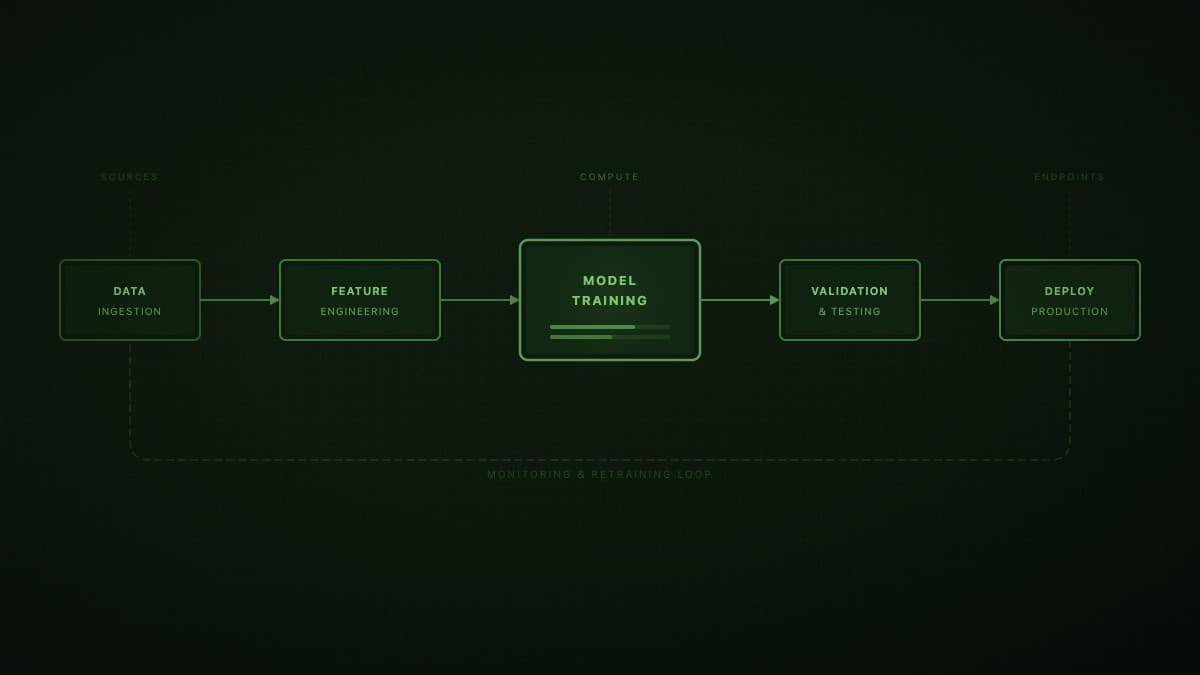
AI & Machine Learning

Agents, models, and pipelines built to survive production

Graduate-level ML engineering applied to real enterprise problems — autonomous LLM agents, RAG systems, multi-agent orchestration, computer vision, classification pipelines, and Bayesian inference. Not tutorials wrapped in an API. Built from the math up.

Production AI. Not demos.Greater PhiladelphiaRemote-FirstProduction-grade ML
10xFaster document processing vs. manual review
75%Reduction in repetitive classification tasks
99.9%Pipeline uptime target for production ML systems
Core capabilities

The full ML stack, not just the LLM layer

Foundation models are one tool. The engineering challenge is knowing when to use them, when classical ML outperforms them, and how to combine both into a system that holds up under real conditions.

AI Agents & Orchestration

Autonomous agents that execute multi-step workflows, call external tools, query knowledge bases, and coordinate with other agents — built with production guardrails, audit logging, and human-in-the-loop checkpoints where the stakes demand it.

LLM Pipelines & RAG Systems

Retrieval-augmented generation systems grounded in your data — with proper chunking strategies, embedding pipelines, hybrid search, re-ranking, and evaluation frameworks that catch failure modes before they reach users.

Classical ML & Bayesian Systems

When foundation models are the wrong tool: classification pipelines, clustering, dimensionality reduction, Bayesian inference, time-series forecasting, and computer vision — the full scientific toolkit applied to problems that demand precision over fluency.
Agentic AI systems

The agentic layer: where automation stops being rigid

Traditional automation breaks when inputs change. Agentic systems reason through variation — calling tools, retrieving context, making decisions, and escalating to humans when confidence is low. We build these systems with the guardrails enterprise environments require.

Multi-agent orchestration

Specialized agents — reasoners, tool-users, retrievers, validators — coordinated to complete complex tasks no single model call can handle reliably. Built on LangGraph, custom orchestration layers, or purpose-built frameworks matched to your constraints.

Marketing automation pipelines

End-to-end content generation systems that produce emails, blog posts, social media content, and infographics — then schedule, post, and surface new content suggestions based on performance data.

Document intelligence

Extraction, classification, and routing for contracts, forms, records, and unstructured text — with grounded retrieval so answers come with verifiable source references, not confident hallucinations.

Workflow copilots

AI assistants embedded in your existing tools that answer questions, summarize context, and reduce manual follow-up — grounded in your internal systems and knowledge base, not general internet knowledge.

AI-powered research systems

Autonomous research agents that gather, synthesize, and structure information across sources — accelerating due diligence, competitive analysis, and knowledge work that currently depends on expensive manual cycles.

Tool-use and API agents

Agents that connect to your internal APIs, databases, and third-party services to take real actions — triggering workflows, updating records, sending notifications — not just generating text about what should happen.
ML engineering team reviewing model evaluation results and pipeline telemetry
Production AI requires evaluation frameworks, not just a demo that works on clean data.

Why most AI projects don't reach production

The demo works on clean data. The production system encounters an edge case nobody tested and silently fails six weeks later. We build the evaluation, monitoring, and guardrail layer that most teams skip.
  • Evaluation frameworks that measure production behavior, not just benchmark scores
  • Human review gates at decision points with non-trivial risk or consequence
  • Audit logging and decision traceability designed for enterprise compliance
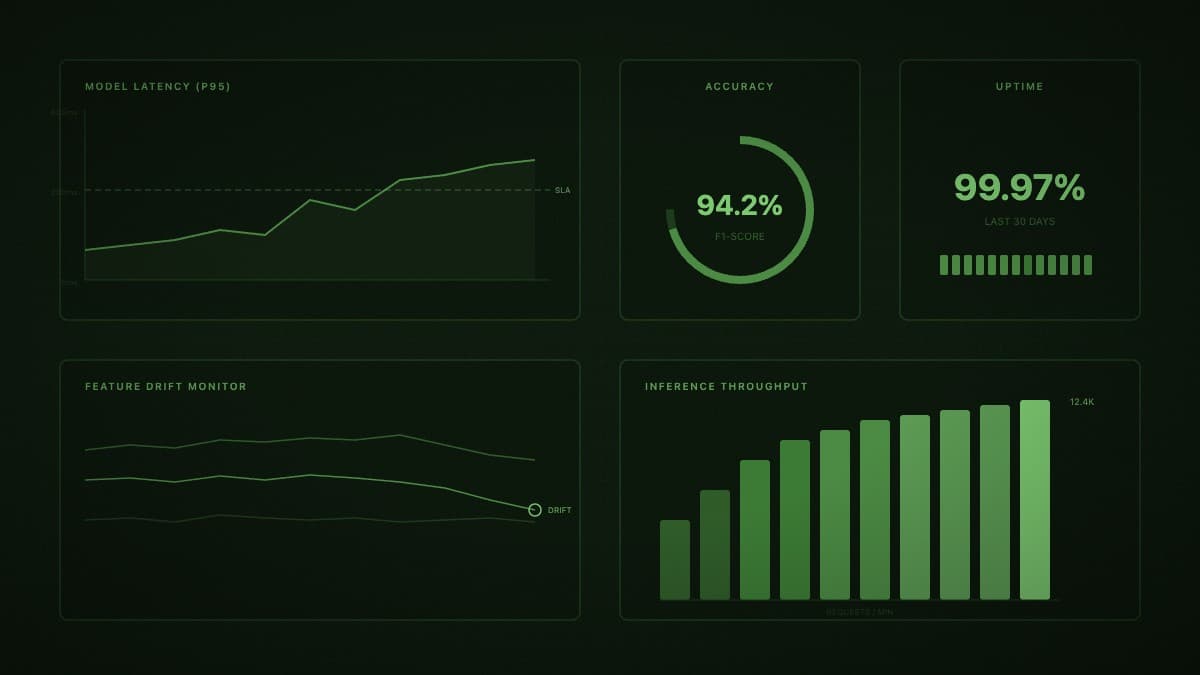
  • Model drift monitoring with automated retraining pipelines where appropriate

Most AI projects fail in production — not because the model was wrong, but because no one built the infrastructure to catch when it was.

ML applications

The methods that don't make headlines but do make systems work

LLMs get all the attention. The most reliable production systems combine foundation model capabilities with classical ML for precision-critical tasks where hallucination is not an acceptable failure mode.
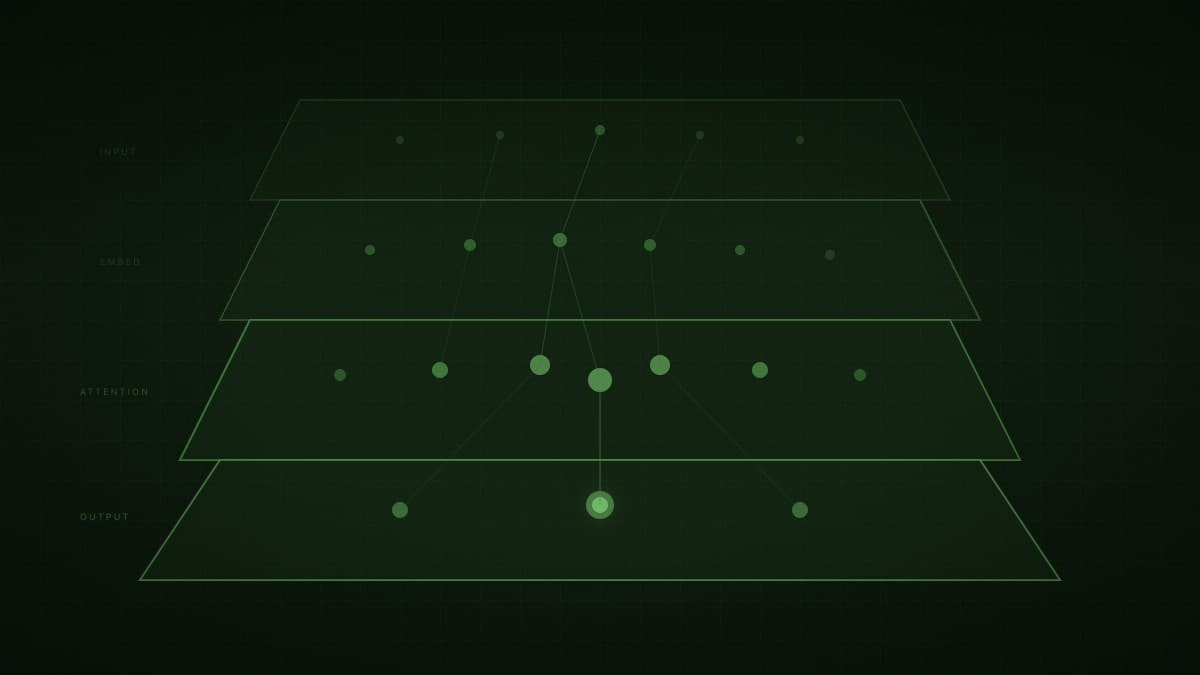
Neural network architecture visualization and model evaluation pipeline
Real-time ML pipeline monitoring dashboard showing model drift and latency metrics

Predictive analytics & forecasting

Demand forecasting, churn prediction, and anomaly detection models grounded in your historical data — evaluated against real business metrics, not benchmark scores on public datasets.

Computer vision pipelines

Visual inspection, defect detection, object recognition, and image classification for manufacturing, healthcare imaging, and operational monitoring — where accuracy requirements make LLMs the wrong choice.

NLP for specialized domains

Clinical text processing, legal document analysis, scientific literature extraction, and domain-specific entity recognition — using fine-tuned models where off-the-shelf performance is insufficient.

Clustering & segmentation

Customer segmentation, behavioral clustering, and pattern discovery in high-dimensional data — using dimensionality reduction and unsupervised methods to surface structure that is not visible in aggregate metrics.
Business outcomes

AI measured against real operational change

We benchmark against workflow speed, accuracy, and reliability — not model performance on held-out test sets that don't reflect production conditions.

10xFaster document processing vs. manual review
75%Reduction in repetitive classification tasks
99.9%Pipeline uptime target for production ML systems
Industry fit

Applied across domains that demand precision

The methods adapt to the domain. The standard for production reliability doesn't.

HealthcareCommercial Real EstateManufacturingLogistics & Supply ChainSaaS & TechnologyPhysics & Scientific Research

Have an AI problem worth solving?

We can help you identify where AI will actually move the needle, separate it from where it will create new problems, and scope a first system worth shipping to production.