Web Engineering

High-performance web platforms engineered to last

Next.js applications and marketing properties built for real traffic, real devices, and editorial teams who should not need an engineer for a content update. Performance and reliability are not afterthoughts — they are the baseline.

Production AI. Not demos.Greater PhiladelphiaRemote-FirstNext.js & Vercel
Delivery targets — performance budgets we commit to
<1.8sTarget LCP on core marketing and product pages
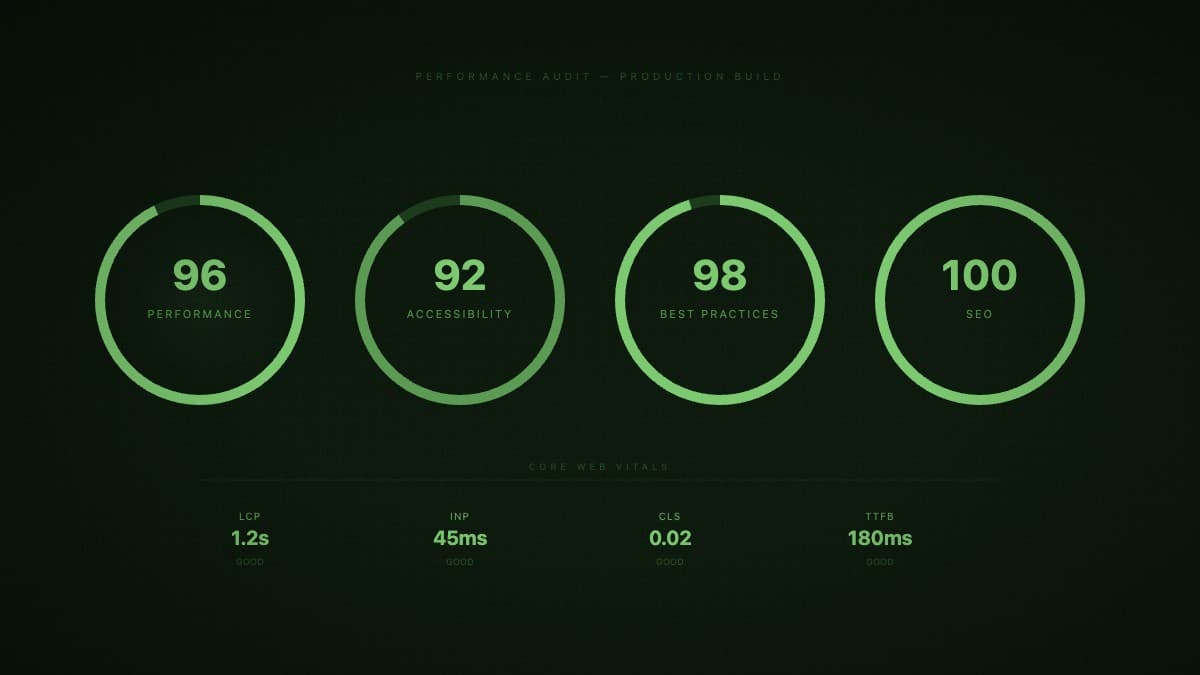
90+Typical Lighthouse performance score post-launch
85%Reduction in oversized media payloads after optimization
99.95%Deployment uptime with rollback and CDN coverage
Web capabilities

The visual layer, the content model, and the deployment path as one system

Three things that are usually treated separately — and should not be. They are designed together so what ships is cohesive and the team that maintains it is not guessing.

Performance-first architecture

Next.js builds with Core Web Vitals, asset budgets, and caching strategy engineered in from the start — so the site is fast on real devices under real network conditions, not just in a lab.

Production-grade deployment

Sensible defaults on Vercel, Netlify, or AWS with uptime targets, rollback paths, CDN configuration, and security handled before launch — not discovered after.

Technical SEO & crawlability

Metadata, schema markup, crawlability, accessibility, and page structure built into the component layer — so search performance is engineered, not retrofitted.
Engineer reviewing Lighthouse scores, Core Web Vitals, and deployment configuration
Performance tuning, content modeling, and deployment are treated as one system — not three separate handoffs.
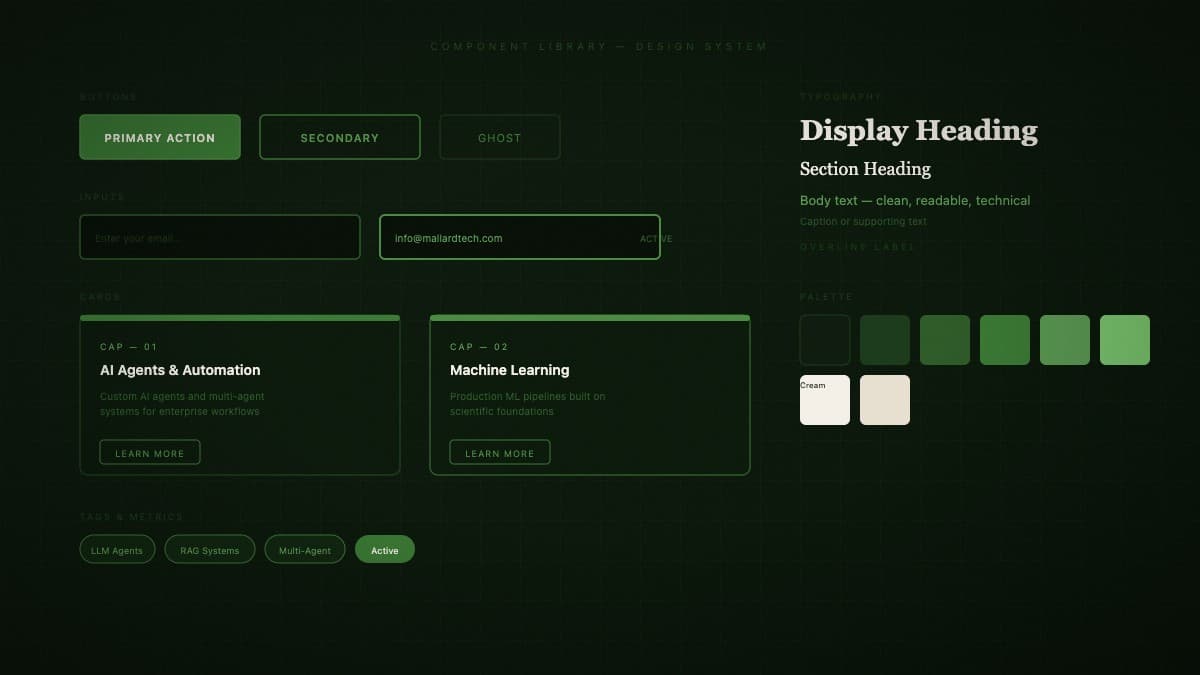
Design system component library with consistent interaction patterns
Engineering standards

Built to be maintainable after launch

The stack stays boring where it should be boring. Clear component contracts, stable deployment rules, and enough instrumentation to catch issues before they reach users.

01 Clean component boundaries

02 Accessible interactions

03 Measured performance budgets

04 Deployment visibility

Marketing & product sites

Fast, structured web properties built to convert — with clean component architecture, solid CMS integration, and page performance that holds up as content grows.

CMS-backed editorial systems

Content workflows your team can maintain without touching code — structured content models, sane publishing paths, and enough flexibility to handle real editorial needs.

AI-integrated web experiences

Web platforms that incorporate LLM capabilities, RAG-powered search, intelligent recommendations, or AI-generated content pipelines — built on the same production-grade foundations.

Performance recovery & rebuilds

Targeted cleanup for slow, bloated, or unmaintainable sites — faster load paths, reduced technical debt, and a deployment process that does not require a specialist every time something changes.

A site that scores 90 on Lighthouse and breaks when a content editor touches it is not done. Performance and maintainability are the same problem.

Delivery targets

Performance budgets we commit to

Performance budgets and runtime monitoring keep experiences fast as content and features scale. These are delivery targets we commit to — not marketing figures.

<1.8sTarget LCP on core marketing and product pages
90+Typical Lighthouse performance score post-launch
85%Reduction in oversized media payloads after optimization
99.95%Deployment uptime with rollback and CDN coverage
How we work

From discovery to production support

A straight line: understand the bottleneck, design the system, integrate with your stack, then keep models and software healthy as traffic and data shift.

Discovery & modeling

We map your data flows, existing tooling, and the real bottleneck — not the one on the slide deck. Success metrics are defined and agreed on before we write a line of code.

Architecture & stack

Model choices, infrastructure, and stack get selected around your actual constraints — latency, cost, compliance, existing systems. Work breaks into milestones with clear deliverables.

Integration & rollout

Short delivery cycles, validated on your data. Everything integrates with the tools your team already uses — not a parallel system your people need to adopt separately.

Iteration & reliability

After launch we monitor model drift, latency, and usage. We tune, retrain, and adjust as your data and requirements shift. Systems get more reliable over time, not less.

Site too slow, too fragile, or too hard to update?

If the current stack requires an engineer for a content change, scores poorly on Core Web Vitals, or breaks in unpredictable ways — we can rebuild it on a foundation that holds.