Simulations & Digital Twins

Run thousands of futures before committing to one

Before you rearrange a factory floor, reconfigure a supply chain, or make a capital decision at scale — build a model of it first. Physics-based simulations and digital twins surface failure modes, bottlenecks, and edge cases in software before they appear in production.

Physics-groundedMonte CarloLive digital twins
10,000+Scenarios simulated per study
99%Capital decisions de-risked in software first
PhysicsGrounded models, not curve-fit approximations
LiveDigital twins synced to real operational data
Core capabilities

Four modeling techniques that cover the problem space

Each method exists because the others fail on the wrong kind of problem. The engineering judgment is knowing which one applies — and when to combine them into a single hybrid model.

Physics-based system models

Accurate replicas of factory lines, hardware systems, and facilities that respond to change the way the real system would — before a single physical component is moved.

Monte Carlo risk analysis

Uncertainty quantified across thousands of simulated scenarios. You understand the distribution of outcomes — not just the average case — before committing to a decision.

Discrete event simulation

Process optimization for logistics, manufacturing, and service operations. Find the bottleneck, test the fix, and validate the throughput improvement before any physical change.

Live digital twin integration

Simulations connected to real operational data so the model stays current as the real system evolves. Continuous insight, not a one-time snapshot.

Build the system in software first. Fix the failures that would have broken the real one.

Applied work

Where simulation changes the decision

The work that benefits most from simulation is the work where a mistake is expensive, irreversible, or both. These are the problem shapes we keep seeing.
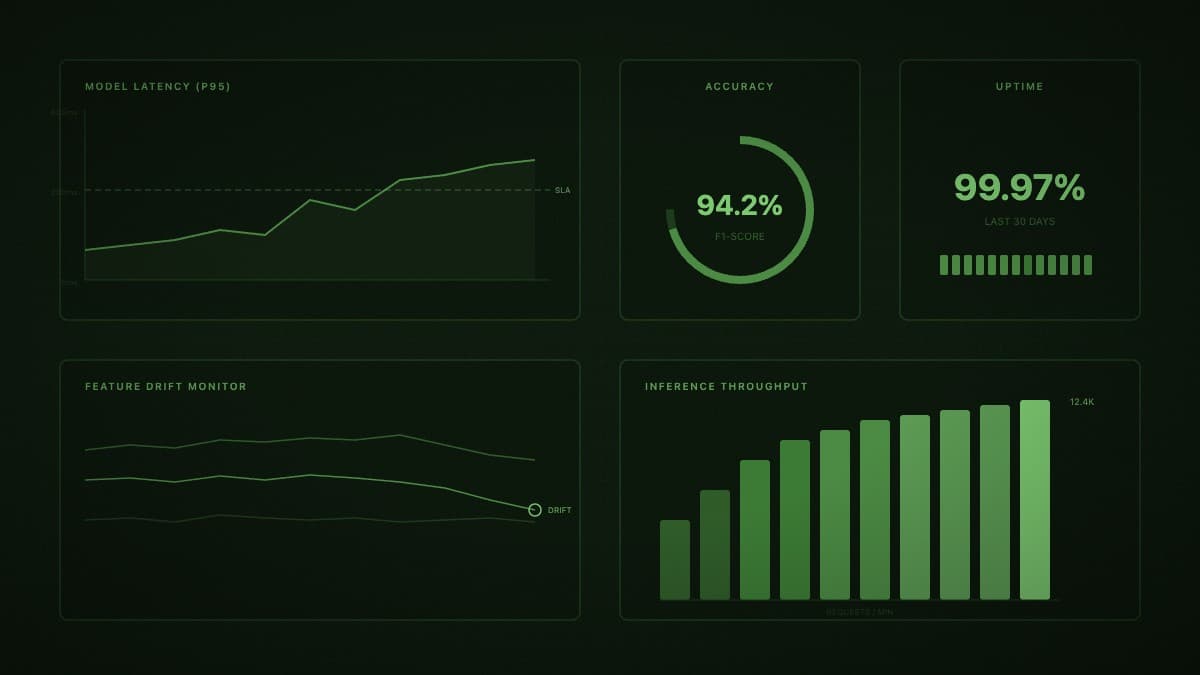
Engineer reviewing a live digital twin dashboard tracking operational telemetry
A live digital twin synced to operational data keeps the model honest as the real system evolves.

Why simulation work fails

Most simulation projects fail because the model is built once, validated on paper, and then never reconnected to the real system. A good digital twin is a living artifact — synced to operational data, re-validated as conditions change, and trusted because its predictions have held up over time.

Factory line redesign

Model the proposed layout, run throughput scenarios, and find the bottleneck before a single machine is moved. The physical change happens only after the software build proves the outcome.

Capital decision de-risking

Run thousands of scenarios across demand, cost, and operational variance to understand the full distribution of outcomes for a large investment — not just the optimistic base case.

Supply chain stress testing

Simulate disruptions, demand spikes, and failure cascades across your logistics network. Identify fragility before it becomes a recall, a stockout, or a late delivery at scale.

Hardware systems validation

Physics-grounded models of mechanical, thermal, and control systems so failure modes surface in simulation — where iteration is cheap — rather than on a test bench or in the field.
Outcomes that matter

Simulation measured against real decisions

We benchmark against decisions avoided, capital saved, and failure modes caught — not the fidelity of the model in isolation.

10,000+Scenarios simulated per study
99%Capital decisions de-risked in software first
PhysicsGrounded models, not curve-fit approximations
LiveDigital twins synced to real operational data
Industry fit

Applied across domains where mistakes are expensive

The methods adapt to the domain. The standard for physical and operational reliability doesn't.

ManufacturingLogisticsHealthcareEnergyScientific ResearchAerospace

Have a decision worth de-risking?

If you're about to commit capital, redesign a system, or change an operational process at scale — a simulation study is cheaper than discovering the failure mode on the other side of the decision.